
REVIEW · QUEENSTOWN NIGHT SKY EXPERIENCES
Stargazing Experience at Cowan’s Private Observatory
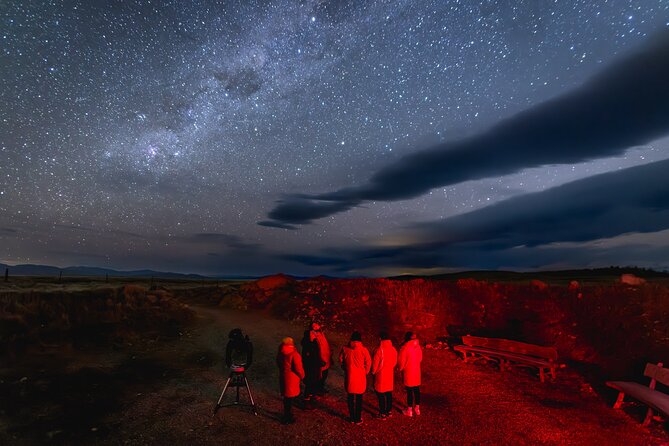
Tekapo at night hits fast. This stargazing experience at Cowan’s Private Observatory puts you inside the Aoraki Mackenzie International Dark Sky Reserve, where stars look sharper and the Milky Way comes into focus faster than you expect. It is built for first-time sky watchers, with guided pointing and telescope views inside sheltered viewing craters.
Two things I really like: the private craters are designed to block wind and light pollution, so you can stay comfortable instead of wrestling the elements. And the guide-led telescope time is practical, with your guide using tools like handheld lasers to help you connect what you see with real constellations and targets.
One thing to think about: this tour can be time-sensitive, especially if you book very late. One bad timing miss can mean you do not catch the shuttle to the observatory, so arrive early and double-check the correct date if your time slot is after midnight.
Key highlights worth planning for

- Gold Standard dark sky location in the Aoraki Mackenzie International Dark Sky Reserve, designed for clear, dark views
- Sheltered private craters that reduce wind and light spill, so the night feels easier
- Telescope viewing with guide support, using handheld lasers so beginners get oriented fast
- Family-friendly stargazing with a minimum age of 5, plus under-17 ticket discounts
- Mobile e-tickets mean you do not need to print anything
Why Lake Tekapo Park’s dark skies work so well

Lake Tekapo is famous for stargazing for a reason, and this experience leans hard into what makes it special. You are in the Mackenzie Basin area, where the night sky is protected and you get that rare combination of lots of sky visibility plus minimal light pollution.
The big advantage is that the tour is built for seeing, not just listening. Your guide helps you find constellations and “hidden secrets” in the sky, and then telescopes put you on specific objects. If you have ever stood under a dark sky and thought, I can’t tell where to look, this kind of guided approach does exactly what you need.
Also, you are not just out in the open. Cowan’s observatory uses a private setup in sheltered craters. That matters more than people think. Cold nights in New Zealand can be brutal, and wind can turn a great stargazing plan into a survival mission. Here, the shelter is part of the design.
Entering the flow: Dark Sky Project check-in to the crater viewing
The tour starts at the Dark Sky Project base in Lake Tekapo. You check in there, then hop on a shuttle for a short ride, about five minutes, to Cowan’s Private Observatory.
This is one of those “small details that saves your night” moments. If you are traveling from Tekapo township, you do not need to figure out remote roads in the dark or worry about finding parking at an observatory location. The tour handles the movement with a dedicated shuttle.
Once you arrive at the observatory, you start with an orientation and early viewing time. The first stop is about 15 minutes, and it is set up to get you comfortable right away. You will be sheltered from wind and light pollution, which helps you settle in and start spotting bright features before the sky gets more “busy” with fainter details.
Stop 1 in the craters: comfort-first stargazing for beginners

Stop 1 happens inside the purpose-built crater area. The point here is not to rush you into deep astronomy jargon. It is to get your bearings fast and let your eyes adjust to darkness.
Your viewing is designed to feel beginner-friendly. The tour is also specifically described as suitable for everyone, including younger children, which tells you something important: the pacing is likely gentle, and the guide’s job is to translate the sky into something you can actually locate.
You might think 15 minutes is short, but it works as a warm-up. That initial window helps you understand what kind of objects you will be focusing on later. It also gets kids and first-timers less overwhelmed, because you are not jumping straight into a long, cold wait with no payoff.
Stop 2 in the Aoraki Mackenzie Dark Sky Reserve

Stop 2 is the “main event,” about 1 hour 15 minutes of guided stargazing. This is where you benefit most from being in the Aoraki Mackenzie International Dark Sky Reserve, noted as a Gold Standard International Dark Sky Reserve.
What does Gold Standard mean for you in real life? It means the skies are among the darkest and clearest you can find, so stars and the Milky Way tend to look more distinct than they do in cities or even many rural spots. The tour leans into that by focusing on southern sky objects and by using telescopes to show you things your naked eyes might only hint at.
Your guide leads you through what is visible that night, which is key. The sky changes by season and by time of night. Cloud cover and haze matter too. So rather than promising the same exact targets every time, the experience is built to match the conditions.
You also get a more interactive approach than you might expect. The guide uses a mix of handheld lasers and powerful telescopes. The laser helps you identify where you are looking in the sky, and the telescope helps you see what is there once you zoom in.
What you can expect to see through the telescopes

One of the most satisfying parts of this tour is that it is aimed at real objects, not just vague “star talk.” Based on what people report after the night, you may see:
- The moon
- Planets such as Jupiter
- Saturn, including the rings, when conditions and timing line up
- Bright Southern Hemisphere constellations, including the Southern Cross
- Star clusters and other sky features that become clearer once you connect the sky map to what is in front of you
A practical note: what you see will depend on the season, the time of night, and cloud cover. So if you have your heart set on a specific planet, the best move is to keep your expectations flexible. The tour itself is structured to tailor the experience to what is visible that night, and that is exactly the right approach in a dark-sky environment where the sky can change fast.
Telescope time inside a private, sheltered setup

The private crater layout is more than a nice setting. It affects your experience.
Because the viewing area is sheltered from wind and light pollution, you spend less time adjusting your clothes, fighting air movement, or watching your comfort collapse. That is a big reason families rate this highly. Kids get cold and restless faster than adults, and the design helps you keep the focus on the sky.
The observatory also uses powerful telescopic viewing technologies. That matters if you are new to stargazing, because telescopes help you make sense of objects you might never properly notice with the naked eye. And because your guide is present, you are not stuck wondering what the blurry dot actually is.
Price and value: what $82.11 buys you

At $82.11 per person, this is not a free backyard stargazing night. But you are paying for three things that are hard to replicate on your own:
First, the dark-sky location is top-tier. Getting this kind of viewing conditions is the core value.
Second, you get guided help. If you have never used the sky before, guidance makes the difference between seeing stars and understanding what you are seeing.
Third, you get telescope viewing in a controlled, sheltered environment, plus return shuttle transport from the Dark Sky Project base.
If you compare it to doing your own trip by car, the money can feel justified once you factor in that you do not need to drive to a remote spot, you do not need to coordinate timing, and you are not left standing cold with no plan. You are also capped at a maximum of 22 travelers, which usually means you are not squeezed into a huge herd.
Who this tour is best for (and who might want a different plan)

This tour fits best if you are:
- A first-time stargazer who wants orientation and help connecting the night sky to real objects
- Traveling with kids, since the minimum age is 5 and children must be accompanied by an adult
- Planning a Lake Tekapo evening and want a structured, low-stress stargazing window
- Someone who values comfort, since the craters are sheltered from wind and light pollution
It may not be ideal if:
- You cannot speak the language used by the tour. The tour requires you to speak the tour language for health and safety reasons, and if you cannot, you will not be allowed to join.
- You need a “guaranteed” clear sky experience. The tour requires good weather, and if it cannot run you will get an alternative indoor experience or a refund.
Weather happens: when the tour shifts indoors
In a dark-sky region, weather can make or break plans. The experience is weather-dependent, and if conditions prevent viewing, the plan can change.
You may be offered an alternate indoor experience, and refunds are available if the tour cannot operate. In practice, that means you are not always left empty-handed. People report indoor explanations being a solid substitute when they could not go out due to clouds.
One more realistic tip: in this area, even if clouds clear later, you might not be able to restart the outdoor session. So the best mindset is to treat the night as a learning and viewing experience, not a strict “must see Saturn” checklist.
Practical tips to get the best night out of it
Dress warm. Even when the day is pleasant, nights in this region can be very cold, and you will be outside for the stargazing portion. Layers help more than you think, especially for kids.
Arrive with enough margin at the Dark Sky Project base. The shuttle timing is part of the schedule, and missing it can spoil your night.
If you are booking a time after midnight, double-check the date. It is easy to slip a day when you are tired or planning late at night, and the tour itself warns about this.
Bring any comfort items you normally use for outdoor events. The tour protects you from wind and light pollution, but it cannot replace warm socks.
Finally, keep your expectations flexible about what you will see. The guides tailor the experience based on what is visible, and the “win” is that you still learn and still look through a telescope even when the sky shifts.
Should you book Cowan’s Private Observatory?
Book it if you want an easy, structured way to experience one of the best dark-sky regions on Earth, with telescope views and a guide who helps you orient quickly. The private crater setup, the short shuttle ride from Lake Tekapo, and the beginner-friendly pacing make it a strong choice for families and first-time stargazers.
Skip it or consider another option if you are very sensitive to delays from weather, or if the requirement to speak the tour language is a problem for you. Also, if your schedule is ultra-tight and you might struggle with late-night arrival timing, give yourself extra buffer.
If you do book, aim for the mindset that this is a guided night sky experience. You will not just stare upward. You will learn what you are seeing, and you may walk away with those wow moments people remember, like seeing Saturn and its rings through the telescope.
FAQ
Where do I check in for Cowan’s Private Observatory?
You check in with the team at the Dark Sky Project base in Lake Tekapo. From there, you are transported to Cowan’s Private Observatory, about a five-minute drive.
How long is the stargazing experience?
The tour is approximately 1 hour 30 minutes.
Is the observatory wheelchair accessible?
Yes, the observatory is accessible to wheelchair users.
Do I need to print my ticket?
No. You receive downloadable mobile e-tickets, so there is no need to find a printer.
What happens if the weather is bad?
The experience requires good weather. If it can’t operate due to poor weather, you can receive a refund, and an alternate indoor experience may be offered.
Is there a minimum age for children?
Yes. The minimum age is 5 years, and children must be accompanied by an adult.
How many people are on the tour?
This experience has a maximum of 22 travelers.
What kinds of objects will I be able to see?
You can expect to discover stars and constellations and observe planets, galaxies, and the Milky Way. What you see can depend on season, time of night, and cloud cover.
Does the price include transport?
Yes. Return transport from the Dark Sky base to the stargazing location is included. Hotel pickup and drop-off are not included.
What if I booked a time after midnight?
If you are booking a time after midnight, double-check the date you are booking to make sure it matches the tour timing.
More Private in Lake Tekapo
- Private Photoshoot in Lake Tekapo
★ 5.0 · 3 reviews
More Tour Reviews in Lake Tekapo
- Lake Tekapo: Alpine Stargazing Experience with a Guide
★ 4.5 · 626 reviews - Lake Tekapo: Stargazing Experience
★ 4.9 · 607 reviews - Tekapo Shuttle: Mt Cook Day Tour via Pukaki & Tasman Lake
★ 4.8 · 307 reviews - Chameleon Stargazing Shared Tour
★ 5.0 · 181 reviews
When the Sky Clears
- Lake Tekapo: Alpine Stargazing Experience with a Guide
★ 4.5 · 626 reviews - Lake Tekapo: Stargazing Experience
★ 4.9 · 607 reviews - Chameleon Stargazing Shared Tour
★ 5.0 · 181 reviews - Lake Tekapo: Mountaintop Stargazing at Mount John Summit
★ 4.5 · 176 reviews
Queenstown Night Sky Experiences, side by side.
 ★ 4.5Lake Tekapo: Alpine Stargazing Experience with a GuideFrom $59626 reviews
 ★ 4.9Lake Tekapo: Stargazing ExperienceFrom $71607 reviews
 ★ 5.0Chameleon Stargazing Shared TourFrom $74181 reviews
 ★ 4.5Lake Tekapo: Mountaintop Stargazing at Mount John SummitFrom $130176 reviews
 ★ 4.5Mount John Observatory Stargazing Experience, TekapoFrom $139160 reviews
 ★ 4.5Tekapo Star Gazing Tour – Soak in the StarsFrom $117109 reviews
 ★ 4.5Silver River Stargazing Experience in Lake TekapoFrom $61106 reviews
 ★ 4.5Dark Sky Indoor Maori Cultural Astronomy ExperienceFrom $3770 reviews
Also filed under